New case / India-Bangladesh / Diplomacy
The border that took 41 years: India and Bangladesh's Land Boundary Agreement
India signed the Land Boundary Agreement with Bangladesh in 1974; Bangladesh ratified it that year, and India, needing a constitutional amendment, took 41 years to follow. The 2011 Protocol rebuilt the deal around residents rather than maps: 111 Indian and 51 Bangladeshi enclaves changed flags at midnight 31 July 2015, adverse possessions stayed as held so their people were not uprooted, and of 38,521 residents of Indian enclaves just 989 chose to move. The bill arrived as the wait itself: roughly 51,000 enclave residents spent four decades without full citizenship rights in either country, and the wider water-sharing agenda slipped with the delay.
3 November 2026 / 7-page decision case
Read the abstract
In 1974 India and Bangladesh signed a Land Boundary Agreement to settle a border inherited from partition, including 162 enclaves whose roughly 51,000 residents lacked full citizenship rights in either country, by India's own account. Bangladesh ratified it that November; India, needing a constitutional amendment, waited 41 years to follow. The 2011 Protocol rebuilt the deal around residents rather than maps: enclaves exchanged, adverse possessions kept as held so their people were not uprooted, everyone offered citizenship. Parliament passed the 100th Amendment in May 2015, all 331 present in the Lok Sabha voting for; instruments exchanged that June, and at midnight 31 July 2015 the 111 Indian and 51 Bangladeshi enclaves changed flags. Of 38,521 residents of Indian enclaves, 989 chose to move to India; all 14,863 in Bangladeshi enclaves stayed as Indians. The case asks what the delay cost, and what Sri Lanka's own unfinished agreements can conditionally borrow.
Brazil / Economic policy
The index that ate indexation: Brazil's 1994 Plano Real
Six stabilization plans in nine years had failed, most built on price freezes. The Plano Real did the opposite: fiscal room first, every step pre-announced, and a four-month bridge unit that unwound indexation before the real launched on 1 July 1994 - monthly INPC inflation fell from 48 percent in June to 1.4 percent by September. The bill arrived through the anchor itself: an overvalued peg defended at 39 percent interest broke in January 1999, and what saved the framework was a successor built in six months - published inflation targets on a primary-surplus foundation.
2 November 2026 / 6-page decision case
Read the abstract
After six failed stabilization plans in nine years - most built on price freezes that only repressed - Brazil dismantled the indexation mechanism itself. The Plano Real announced every step in advance, built fiscal room first, and ran a four-month bridge unit, the URV, so wages and contracts repriced in stable terms before the real launched on 1 July 1994. Monthly INPC inflation fell from 48 percent in June to 1.4 percent by September, and poverty in six metropolitan areas fell from 42 percent in July 1994 to 27 percent in December 1995. The anchor then became the risk: the primary surplus eroded within two years and an overvalued peg broke in January 1999 - survived because inflation targeting on a primary-surplus foundation was operational within six months. The case asks what sequencing buys, and what Sri Lanka's October 2026 target can conditionally borrow.
Indonesia / Diplomacy
Trading independence for self-government: the 2005 Aceh settlement
Talks were agreed days before the tsunami - the wave was a pretext, not the cause. Five Helsinki rounds traded independence for self-government: 840 weapons surrendered, 24,000 troops withdrawn, 1,424 prisoners freed, and former rebels contesting every election since. The security half of the bargain has held for twenty years; the promised human-rights court and full truth commission have not, and contested implementation figures are carried as attributed assessments.
31 October 2026 / 7-page decision case
Read the abstract
In December 2004, days before the tsunami, Indonesia's new government and the Free Aceh Movement agreed to meet; the wave that killed at least 128,000 Acehnese turned that meeting into a settlement. Five rounds in Helsinki produced the August 2005 memorandum: GAM set aside independence for self-government, and Jakarta conceded local political parties, an amnesty, seventy percent of natural-resource revenues and a European-ASEAN monitoring mission empowered to rule on disputes. Within five months GAM had surrendered its 840 weapons, 24,000 troops had withdrawn and 1,424 prisoners walked free. Former rebels have contested every election since, winning and losing power. The war has not returned in twenty years; the promised human-rights court and full truth commission largely have not arrived. This case examines the autonomy trade: what each side conceded, why it held, and what Sri Lanka, still waiting on its own long-delayed provincial council elections, can conditionally draw from it.
New Zealand / Economic policy
Six years at full speed
Six years of floats, subsidy abolition, corporatization and tax reform: inflation fell from nearly 19 percent in 1987 to about 2 by 1991, and the framework legislated from 1989 still binds policy in 2026 through successor statutes. The other half of the record - unemployment near 11 percent by 1992 and a decade-long recovery for the poorest households - is carried as attributed, contested estimates.
30 October 2026 / 8-page decision case
Read the abstract
In July 1984 New Zealand's incoming Labour government inherited a frozen, subsidized economy and a currency under siege; within six years it had floated the dollar, abolished farm subsidies that had absorbed over a third of pastoral output, turned government trading departments into companies, halved the top income-tax rate, introduced a broad consumption tax and legislated the world's first central-bank inflation target. Both parties kept the core. The measured record is double-sided: inflation fell from nearly 19 percent in 1987 to about 2 percent by 1991, and the framework legislated from 1989 still binds policy in 2026 through successors, while unemployment rose from 3.6 percent in 1986 to about 11 percent by 1992 and the poorest households waited over a decade to recover. This case examines speed as a deliberate policy choice: what it bought, what it cost, who paid, and what Sri Lanka can now conditionally draw from it.
Sri Lanka / Trade
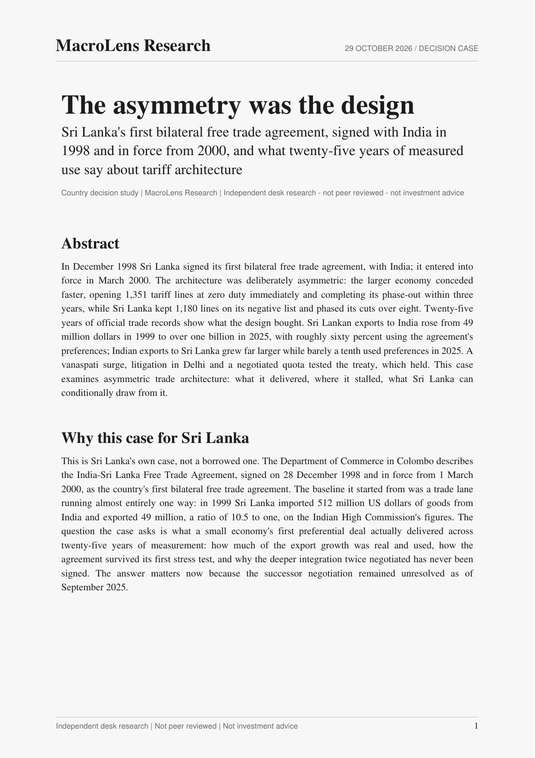
The asymmetry was the design
The larger economy conceded faster: India opened 1,351 tariff lines at zero duty immediately and finished its phase-out in three years, while Sri Lanka sheltered 1,180 lines and took eight. Twenty-five years of official records show a billion-dollar export lane, a vanaspati stress test absorbed - and a deepening twice negotiated, never signed.
29 October 2026 / 8-page decision case
Read the abstract
In December 1998 Sri Lanka signed its first bilateral free trade agreement, with India; it entered into force in March 2000. The architecture was deliberately asymmetric: the larger economy conceded faster, opening 1,351 tariff lines at zero duty immediately and completing its phase-out within three years, while Sri Lanka kept 1,180 lines on its negative list and phased its cuts over eight. Twenty-five years of official trade records show what the design bought. Sri Lankan exports to India rose from 49 million dollars in 1999 to over one billion in 2025, with roughly sixty percent using the agreement's preferences; Indian exports to Sri Lanka grew far larger while barely a tenth used preferences in 2025. A vanaspati surge, litigation in Delhi and a negotiated quota tested the treaty, which held. This case examines asymmetric trade architecture: what it delivered, where it stalled, what Sri Lanka can conditionally draw from it.
Sri Lanka / Diplomacy
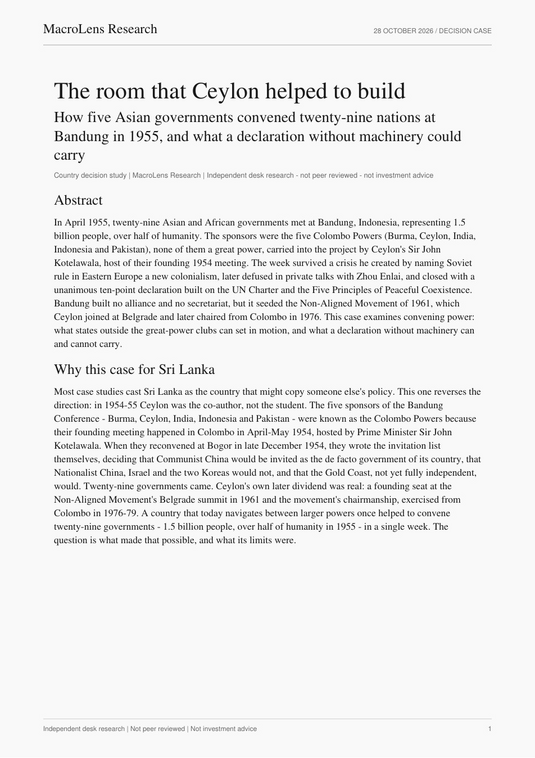
The room that Ceylon helped to build
Five Colombo Powers convened twenty-nine Asian and African governments at Bandung in April 1955, with Ceylon's Sir John Kotelawala at the centre of both the founding meeting and the week's crisis. The convening dividend - Belgrade in 1961, the chairmanship from Colombo in 1976 - is kept beside the limits of a declaration without machinery.
28 October 2026 / 6-page decision case
Read the abstract
In April 1955, twenty-nine Asian and African governments met at Bandung, Indonesia, representing 1.5 billion people, over half of humanity. The sponsors were the five Colombo Powers (Burma, Ceylon, India, Indonesia and Pakistan), none of them a great power, carried into the project by Ceylon's Sir John Kotelawala, host of their founding 1954 meeting. The week survived a crisis he created by naming Soviet rule in Eastern Europe a new colonialism, later defused in private talks with Zhou Enlai, and closed with a unanimous ten-point declaration built on the UN Charter and the Five Principles of Peaceful Coexistence. Bandung built no alliance and no secretariat, but it seeded the Non-Aligned Movement of 1961, which Ceylon joined at Belgrade and later chaired from Colombo in 1976. This case examines convening power: what states outside the great-power clubs can set in motion, and what a declaration without machinery can and cannot carry.
Israel / Economic policy
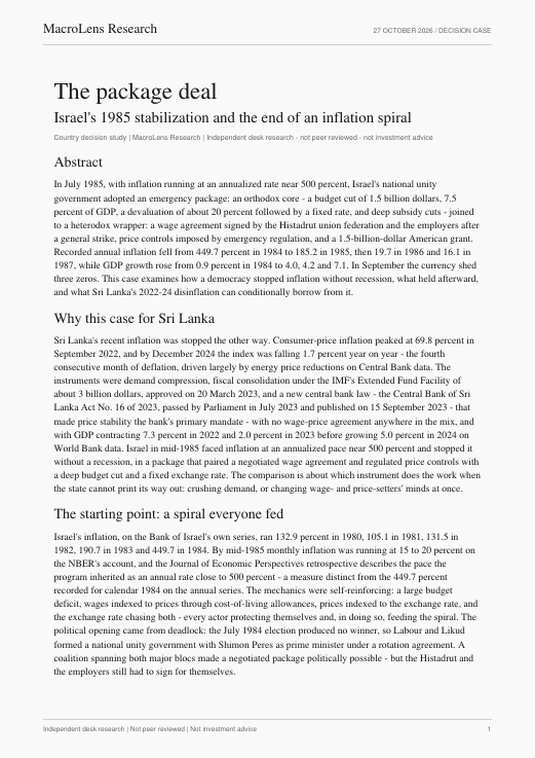
The package deal
Israel's July 1985 package joined a deep budget cut and a fixed exchange rate to a wage agreement signed after a general strike. The recession-free disinflation is kept beside the strategic grant no debtor can order up.
27 October 2026 / 5-page decision case
Read the abstract
In July 1985, with inflation running at an annualized rate near 500 percent, Israel's national unity government adopted an emergency package: an orthodox core - a budget cut of 1.5 billion dollars, 7.5 percent of GDP, a devaluation of about 20 percent followed by a fixed rate, and deep subsidy cuts - joined to a heterodox wrapper: a wage agreement signed by the Histadrut union federation and the employers after a general strike, price controls imposed by emergency regulation, and a 1.5-billion-dollar American grant. Recorded annual inflation fell from 449.7 percent in 1984 to 185.2 in 1985, then 19.7 in 1986 and 16.1 in 1987, while GDP growth rose from 0.9 percent in 1984 to 4.0, 4.2 and 7.1. In September the currency shed three zeros. This case examines how a democracy stopped inflation without recession, what held afterward, and what Sri Lanka's 2022-24 disinflation can conditionally borrow from it.
South Korea / Trade
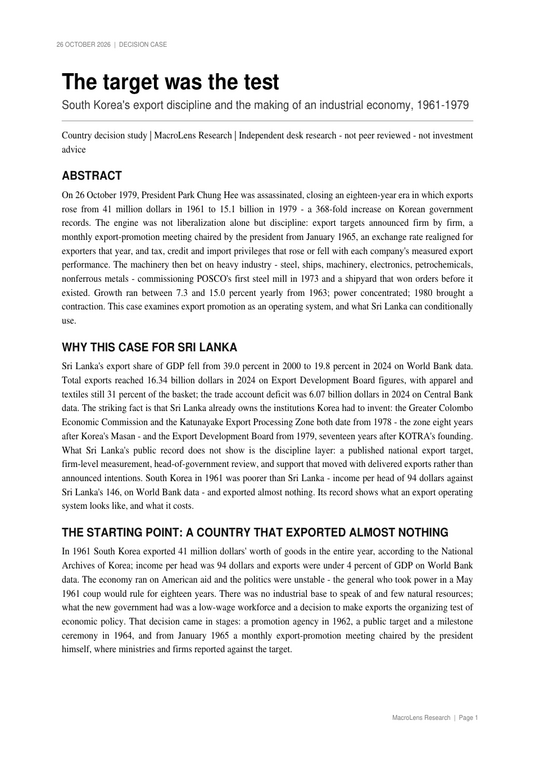
The target was the test
South Korea made exports the organising test of policy: firm-level targets, a monthly president-chaired review, and support that moved with delivered exports. The authoritarian costs are stated beside the discipline.
26 October 2026 / 5-page decision case
Read the abstract
On 26 October 1979, President Park Chung Hee was assassinated, closing an eighteen-year era in which exports rose from 41 million dollars in 1961 to 15.1 billion in 1979 - a 368-fold increase on Korean government records. The engine was not liberalization alone but discipline: export targets announced firm by firm, a monthly export-promotion meeting chaired by the president from January 1965, an exchange rate realigned for exporters that year, and tax, credit and import privileges that rose or fell with each company's measured export performance. The machinery then bet on heavy industry - steel, ships, machinery, electronics, petrochemicals, nonferrous metals - commissioning POSCO's first steel mill in 1973 and a shipyard that won orders before it existed. Growth ran between 7.3 and 15.0 percent yearly from 1963; power concentrated; 1980 brought a contraction. This case examines export promotion as an operating system, and what Sri Lanka can conditionally use.
Costa Rica / Trade
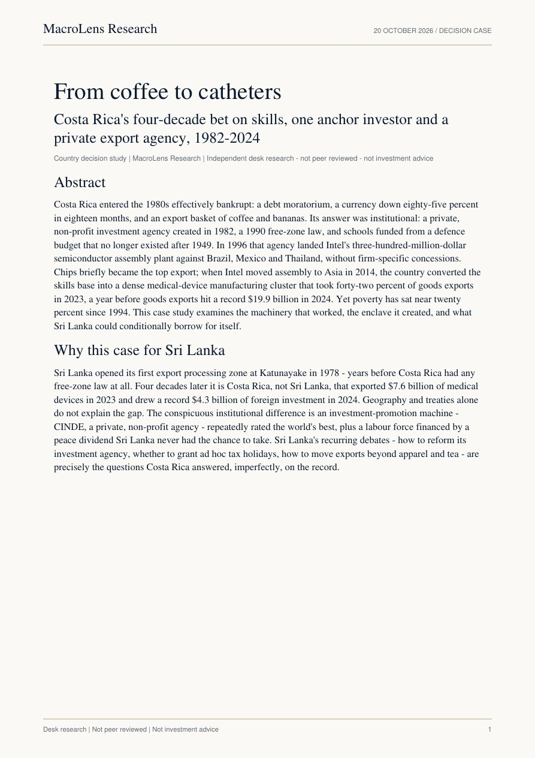
From coffee to catheters
Costa Rica built an investor-service machine and a medical-device cluster. Export gains are kept beside education, distribution and transfer limits.
20 October 2026 / 8-page decision case
Read the abstract
Costa Rica entered the 1980s effectively bankrupt: a debt moratorium, a currency down eighty-five percent in eighteen months, and an export basket of coffee and bananas. Its answer was institutional: a private, non-profit investment agency created in 1982, a 1990 free-zone law, and schools funded from a defence budget that no longer existed after 1949. In 1996 that agency landed Intel's three-hundred-million-dollar semiconductor assembly plant against Brazil, Mexico and Thailand, without firm-specific concessions. Chips briefly became the top export; when Intel moved assembly to Asia in 2014, the country converted the skills base into a dense medical-device manufacturing cluster that took forty-two percent of goods exports in 2023, a year before goods exports hit a record $19.9 billion in 2024. Yet poverty has sat near twenty percent since 1994. This case study examines the machinery that worked, the enclave it created, and what Sri Lanka could conditionally borrow for itself.
New case / Northern Ireland / Diplomacy
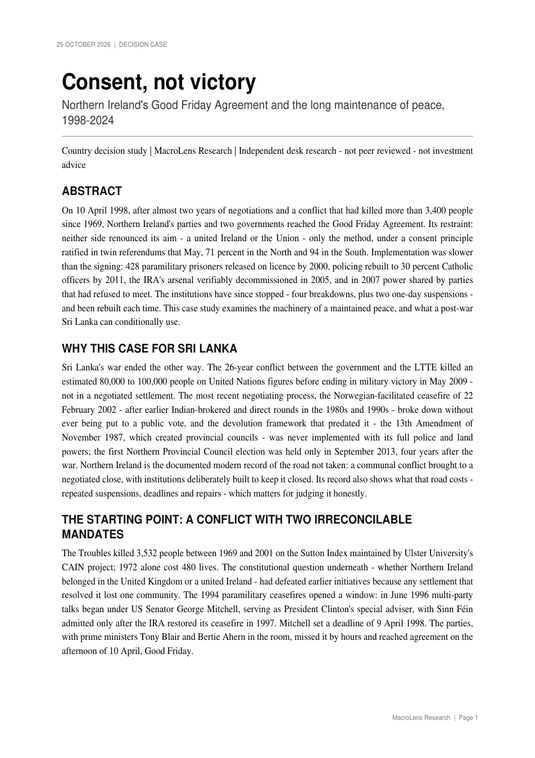
Consent, not victory
Northern Ireland's Good Friday Agreement and the long maintenance of peace, 1998-2024.
25 October 2026 / 5-page decision case
Read the abstract
On 10 April 1998, after almost two years of negotiations and a conflict that had killed more than 3,400 people since 1969, Northern Ireland's parties and two governments reached the Good Friday Agreement. Its restraint: neither side renounced its aim - a united Ireland or the Union - only the method, under a consent principle ratified in twin referendums that May, 71 percent in the North and 94 in the South. Implementation was slower than the signing: 428 paramilitary prisoners released on licence by 2000, policing rebuilt to 30 percent Catholic officers by 2011, the IRA's arsenal verifiably decommissioned in 2005, and in 2007 power shared by parties that had refused to meet. The institutions have since stopped - four breakdowns, plus two one-day suspensions - and been rebuilt each time. This case study examines the machinery of a maintained peace, and what a post-war Sri Lanka can conditionally use.
New case / Iceland / Economic policy
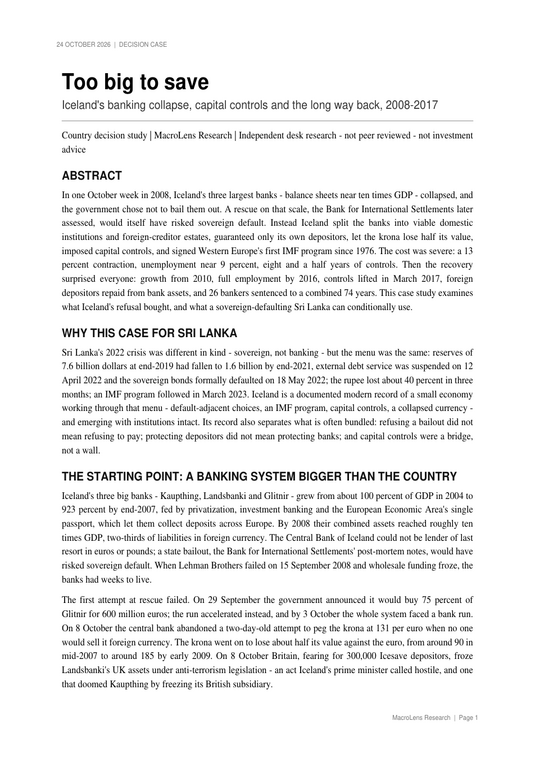
Too big to save
Iceland's banking collapse, capital controls and the long way back, 2008-2017.
24 October 2026 / 5-page decision case
Read the abstract
In one October week in 2008, Iceland's three largest banks - balance sheets near ten times GDP - collapsed, and the government chose not to bail them out. A rescue on that scale, the Bank for International Settlements later assessed, would itself have risked sovereign default. Instead Iceland split the banks into viable domestic institutions and foreign-creditor estates, guaranteed only its own depositors, let the krona lose half its value, imposed capital controls, and signed Western Europe's first IMF program since 1976. The cost was severe: a 13 percent contraction, unemployment near 9 percent, eight and a half years of controls. Then the recovery surprised everyone: growth from 2010, full employment by 2016, controls lifted in March 2017, foreign depositors repaid from bank assets, and 26 bankers sentenced to a combined 74 years. This case study examines what Iceland's refusal bought, and what a sovereign-defaulting Sri Lanka can conditionally use.
New case / Jordan / Trade
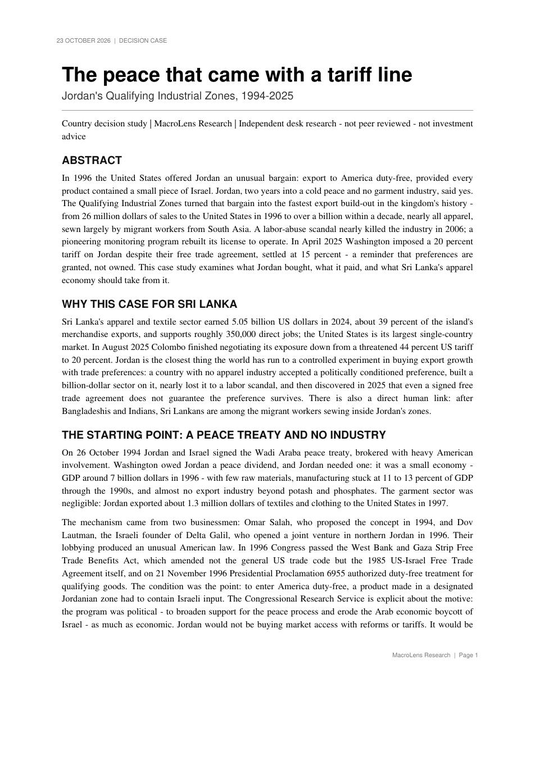
The peace that came with a tariff line
Jordan's Qualifying Industrial Zones, 1994-2025.
23 October 2026 / 5-page decision case
Read the abstract
In 1996 the United States offered Jordan an unusual bargain: export to America duty-free, provided every product contained a small piece of Israel. Jordan, two years into a cold peace and no garment industry, said yes. The Qualifying Industrial Zones turned that bargain into the fastest export build-out in the kingdom's history - from 26 million dollars of sales to the United States in 1996 to over a billion within a decade, nearly all apparel, sewn largely by migrant workers from South Asia. A labor-abuse scandal nearly killed the industry in 2006; a pioneering monitoring program rebuilt its license to operate. In April 2025 Washington imposed a 20 percent tariff on Jordan despite their free trade agreement, settled at 15 percent - a reminder that preferences are granted, not owned. This case study examines what Jordan bought, what it paid, and what Sri Lanka's apparel economy should take from it.
New case / Southeast Asia / Diplomacy
The war nobody declared
Konfrontasi, the Bangkok Accord and the founding of ASEAN, 1963-1967.
22 October 2026 / 8-page decision case
Read the abstract
Indonesia declared “confrontation” in January 1963 against a Malaysia that did not yet exist; three years later the two countries signed a three-article accord in Jakarta, and eleven months after that they founded ASEAN together with three neighbours. The war - infiltrations across Borneo and the Malacca Strait, 114 Commonwealth soldiers killed, a burned embassy, and Indonesia's walkout from the United Nations in January 1965 - ended not with victory but with a change of regime in Jakarta and a face-saving text: Sabah and Sarawak would “reaffirm” a decision nobody intended to reverse. And the peace held. The club it produced counts eleven members; members have exchanged fire, but never a full-scale internal war, and trade integration has barely deepened since 2003. This case study examines how the Bangkok Accord ended Southeast Asia's undeclared war, what ASEAN actually delivered, and what SAARC's members, Sri Lanka among them, might conditionally borrow.
New case / Bolivia / Economic policy
Ten days to stop a hyperinflation
Bolivia's Decree 21060 and the New Economic Policy, 1985-1990.
21 October 2026 / 8-page decision case
Read the abstract
Bolivia in August 1985 had the world's fastest inflation: prices rose twenty thousand percent in twelve months, the treasury collected one percent of GDP in taxes, and the dollar had become the country's unit of account. Three weeks after taking office, President Victor Paz Estenssoro - the seventy-seven-year-old founder of the party that had nationalized the mines - signed Decree 21060, floating the currency, freezing public wages, raising fuel prices to world levels, and keeping a debt moratorium the IMF disliked. Prices stopped rising within two weeks. Then world tin prices halved, and more than twenty thousand miners lost their jobs; an emergency social fund, created three months after the decree and rebuilt a year later, ran employment projects for them. Growth returned in 1987, but per-capita income kept falling. This case study examines how the decree worked, what it cost, and what Sri Lanka's post-2022 stabilization could conditionally borrow.
New case / Mozambique / Diplomacy
A peace built around a table
A private peace table, a funded UN implementation mission and two decades of growth, with the relapse and transfer limits kept in view.
19 October 2026 / 8-page decision case
Read the abstract
Mozambique's civil war killed about one million people and displaced five million before it ended not on a battlefield but at the Rome headquarters of a Catholic lay community. Between 1990 and 1992 the Community of Sant'Egidio, alongside the Italian government, mediated roughly a dozen rounds of talks between the government and Renamo rebels, producing a seven-protocol peace agreement. A United Nations operation then did the unglamorous work: monitoring the ceasefire, demobilising 76,000 soldiers, paying them to go home, funding the rebels' conversion into a political party, and supervising elections that the losing side nearly abandoned mid-vote. Growth then averaged nearly eight percent for two decades. Yet poverty fell slowly, the settlement partly unravelled into renewed fighting in 2013, and an unrelated insurgency opened in 2017. This case study examines how the mediation and implementation actually worked, what was measured, what later failed, and what Sri Lanka might conditionally borrow.
New case / Georgia / Economic policy
The state rebuilt its counters
Tax, traffic police and service counters were rebuilt around simpler rules, changed staffing and visible measurements. The revenue gains stay beside the jobs and accountability limits.
18 October 2026 / 8-page decision case
Read the abstract
Georgia in 2003 collected taxes nobody could calculate, through a police force motorists paid at the roadside. After the Rose Revolution, a new government cut the tax code from twenty-one taxes to six, fired sixteen thousand traffic police overnight, rebuilt service delivery around one-stop halls, and locked future tax increases behind a public referendum. Tax revenue doubled to about a quarter of GDP by 2008; the corruption-perception index moved Georgia from 124th of 133 countries to 51st of 176 by 2012; growth averaged more than six percent a year across a full decade of reform. Yet unemployment stayed in double digits, the reform party lost power in 2012, and later assessments found petty bribery beaten but grand-corruption risks alive. This case study examines the mechanics of the cleanup, what was measured, what was not fixed, and which of those lessons could conditionally transfer to Sri Lanka's own unfinished state-capacity debate.
New case / Morocco / Trade
The port and the factory were one deal
Tanger Med, anchor car plants and the ecosystem bargain. Export gains, transshipment and the 2025 reversal are measured separately.
17 October 2026 / 8-page decision case
Read the abstract
Morocco decided in 2002 to build a new port on the Strait of Gibraltar and, almost at the same time, to reserve the land beside it for a car plant that existed only on paper. Tanger Med opened in 2007; Renault signed its Tangier plant months later and produced from 2012; a second manufacturer, PSA, followed in 2019 at Kenitra. Vehicles and components passed phosphates as Morocco's top export in 2014 and reached 157.6 billion dirhams in 2024, while the port handled 10.24 million TEU, mostly transshipment. The state supplied land, infrastructure, training institutes and conditional support through 'ecosystem' contracts; investors supplied production and supplier networks. Then 2025 brought the sector's first export decline in years as European demand slowed, and the goods trade deficit stayed near a fifth of GDP. This case examines the sequence, the measured outcomes, the limits, and what could conditionally transfer to Sri Lanka itself.
New case / Montreal Protocol / Diplomacy
A treaty needs a working transition
Controls need finance, technical capacity and review. Conditional ozone-recovery projections are not completed outcomes.
16 October 2026 / 8-page decision case
Read the abstract
The Montreal Protocol joined international controls on ozone depleting chemicals to a process for scientific review, differentiated implementation and support. Its original agreement was not the complete phaseout system that developed later. Subsequent decisions strengthened controls, while a financial mechanism helped eligible developing countries meet agreed incremental costs. Reporting and atmospheric observation provided different ways to test progress, including evidence of unexpected emissions. The scientific assessment published in 2022 reported declining chlorine and bromine entering the stratosphere and signs of ozone recovery, but also uncertainty and regional differences. Projected returns to 1980 ozone levels remain conditional forecasts, not completed outcomes. Technology choices can introduce new climate, safety and maintenance problems, so substitution needs evaluation rather than a simple label. For Sri Lanka, the conditional lesson is to connect diplomatic commitments with data, finance, technical capacity and review. Montreal offers a design discipline, not proof that every environmental bargain transfers unchanged.
New case / Sweden / Economic policy
Protect the system, not every shareholder
Creditor confidence, loss recognition and ownership consequences must fit together. A guarantee does not erase bank losses.
15 October 2026 / 8-page decision case
Read the abstract
Sweden's banking crisis forced authorities to distinguish financial stability from protecting bank owners. A guarantee supported creditor confidence, while public capital, loss recognition and restructuring addressed damaged balance sheets. Asset management companies separated troubled loans from continuing bank operations, but moving assets did not make their losses disappear. Official participant accounts describe conditional support, valuation work and private recapitalization alongside state intervention. The banking system returned to aggregate profit in 1994, and the guarantee ended in July 1996. These milestones do not establish that every bank recovered or that society escaped recession costs. Fiscal assessments also differ with timing, scope and treatment of recoveries; gross support cannot be called the final taxpayer loss. Sweden's experience offers Sri Lanka conditional questions about credible funding, legal powers, ownership consequences and transparent accounting. It does not justify an unlimited guarantee without fiscal capacity or a bad bank without valuation, governance and recovery expertise.
New case / Mauritius / Trade
An export window is not a permanent advantage
Build capability while the export window is open. Prepare workers for the adjustment when advantages fade.
14 October 2026 / 8-page decision case / Review draft
Read the abstract
Mauritius developed an export processing regime while maintaining protection elsewhere in its economy. Duty free inputs, incentives, market access and production knowledge helped firms enter manufacturing exports, but no single policy explains the island's wider development. Original research emphasizes institutions and historically specific advantages, including trade preferences and investor networks. The same bargain also involved unequal labor conditions that should not disappear inside a success story. Official statistics reveal a later adjustment test: export processing employment fell sharply between December 1999 and December 2004, and apparel jobs continued declining into June 2005. Export receipts, imports, value added and worker outcomes are different measures. Preference erosion and changing competition made adaptation necessary, although these data alone cannot assign every job loss to one external change. For Sri Lanka, the conditional lesson is to remove obstacles to competitive production while funding skills, protecting workers and preparing for advantages that may not last.
New case / Helsinki / Diplomacy
A promise needs a second meeting
A signature made promises public. Review kept disputed delivery on the agenda.
13 October 2026 / 7-page decision case / Review draft
Read the abstract
In August 1975, thirty five participating states signed the Helsinki Final Act, combining security principles, economic cooperation and human contacts within one diplomatic framework. The bargain did not end ideological rivalry, legally freeze borders or create a court to enforce every promise. Its importance lay partly in making public commitments available for later scrutiny. Contemporary American records show leaders expecting a process, not a completed peace. The text protected sovereignty while also recognizing human rights and peaceful changes of frontiers by agreement. Follow up meetings kept disputed implementation on the agenda, despite repression and renewed confrontation. Later Vienna and Moscow procedures added ways to raise concerns and seek independent expertise. These institutional developments are observable; a causal share in ending the Cold War is not established here. For Sri Lanka, the conditional lesson is to pair diplomatic promises with duties, evidence, review and remedies, rather than treating signatures as delivery.
New case / Chile / Economic policy
Saving the windfall before the shock
A temporary windfall can become a permanent spending promise.
12 October 2026 / 7-page decision case / Review draft
Read the abstract
Chile began applying a structural fiscal rule in 2001 to separate sustainable public revenue from fluctuations in economic activity and copper prices. Independent technical inputs, budget procedures and later sovereign funds helped turn the principle into an operating framework. During the copper boom, the government saved rather than converting all temporary receipts into recurring commitments. The global crisis then created a test of whether those buffers could support public spending when revenue weakened. This case distinguishes observed fund withdrawals, announced stimulus and model-based assessments of stabilization. It also examines target changes, estimation uncertainty and the danger of calling every adjustment structural. Chile's experience does not prove that one rule caused national resilience or that saving always dominates urgent investment. For Sri Lanka, the conditional lesson is to connect realistic assumptions, transparent review, debt risks and funded shock responses, rather than copy a copper-based formula or create a fund without resources.
New case / Bangladesh / Trade and worker safety
Export growth needs a safety system
Export capability grew. Worker protection did not follow automatically.
11 October 2026 / 7-page decision case / Review draft
Read the abstract
Bangladesh's garment industry grew through imported production knowledge, access to inputs and finance, and the spread of export capabilities beyond pioneering firms. Yet success did not guarantee safe workplaces. The Rana Plaza collapse in April 2013 exposed the human cost of weak protection and forced a new implementation question: who would inspect factories, finance repairs, hear workers and verify completion? This case connects an early export-learning account with original post-disaster commitments and later institutional reports. Inspection coverage, compensation payments and reported export scale are distinguished from proof that every factory became safe or every worker gained. The evidence supports neither a simple low-wage success story nor a claim that safety automatically follows growth. For Sri Lanka, the conditional lesson is to treat production capability and worker protection as joint requirements, with clear responsibilities, funded remediation, accessible complaints and separate measures of export revenue, locally retained income and workers' lived conditions.
New case / Egypt-Israel / Diplomacy
Two frameworks, unequal outcomes
Two frameworks were signed. Their outcomes were not the same.
10 October 2026 / 7-page decision case / Review draft
Read the abstract
The Camp David summit of September 1978 produced two frameworks: one for a broader Middle East settlement and another for an Egyptian-Israeli peace treaty. This case asks why a bounded bilateral agreement became implementable while the Palestinian track remained unresolved. Original texts, correspondence and negotiating records show the importance of staged obligations, domestic approval, disputed language and third-party commitments. The March 1979 treaty specified withdrawal, normalization, security zones and dispute procedures; a monitoring organization began work in April 1982 when the principal Sinai withdrawal concluded. These are observable milestones, not proof that the accords solved the regional conflict or created equal benefits for everyone. United Nations criticism and the absence of Palestinian participation expose the limits of bargaining over people outside the negotiating room. For Sri Lanka, the conditional lesson is to distinguish a signed framework from authorized, verified execution, while keeping unresolved rights and representation visible throughout the process.
New case / Canada / Economic policy
A number is not yet credibility
Inflation fell faster than expected. The economy was weaker than expected too.
9 October 2026 / 7-page decision case / Review draft
Read the abstract
Canada introduced explicit inflation reduction targets in 1991, linking the central bank and government to a published path toward price stability. Inflation fell rapidly, but the announcement did not instantly establish credibility, and disinflation coincided with recession and a slow recovery. This case distinguishes the target, the operating tools and the measured outcome. Original policy documents show gradual milestones, tolerance bands and attention to exceptional price shocks. Contemporary reporting explains how forecasts, interest rates, exchange rates and communication supported implementation. Official price indexes document lower inflation; they do not identify the target's independent causal effect. Institutional retrospectives and an external assessment differ in emphasis on credibility and adjustment costs. For Sri Lanka, the conditional lesson is to connect a clear objective to dependable institutions, fiscal consistency, usable evidence and public explanations. Copying Canada's number alone cannot guarantee stable prices, a painless transition or the same economic outcome under different conditions.
New case / Vietnam / US / Trade
Opening a market, building a response
Orders could move quickly. Firms, factories and workers would adjust over years.
8 October 2026 / 7-page decision case / Review draft
Read the abstract
Vietnam's bilateral trade agreement with the United States took effect in December 2001, sharply reducing tariffs on Vietnamese goods while committing Vietnam to changes in commercial rules. This case asks how market access became productive capacity rather than a diplomatic announcement. Official trade data show rapid growth in American goods imports from Vietnam after implementation. Original research traces employment responses across industries and provinces, identifying foreign firm entry, expansion after entry, and shifts from agriculture toward manufacturing and services. These findings are separated from descriptive national totals and remain conditional on empirical assumptions. Vietnam's experience does not establish that every agreement increases employment, that foreign investment automatically develops domestic suppliers, or that later export growth came from one treaty. For Sri Lanka, the conditional lesson is to pair verified access with dependable execution, worker support and measures of domestic value, rather than judge success by signatures or announced investment alone.
New case / Turkey / Trade
Rule-taker by choice: Turkey's 1996 customs union with the European Union
A customs union without a seat at the table: Turkey adopted the EU's external tariff, scrapped bilateral origin rules and mirrored European regulation, and goods exports rose from 23 billion dollars in 1996 to a record 262 billion in 2024. The World Bank credits the tariff anchor, origin-free trade and the regulatory mirror; the bill arrived as obligations without voice in the EU's third-country deals and a modernization round unstarted since 2016.
1 November 2026 / 6-page decision case
Read the abstract
On 1 January 1996 Turkey did what no large economy had: it put its industrial goods inside the European Union's tariff wall without a seat at the table. It adopted the EU's common external tariff, scrapped bilateral rules of origin, and bound Ankara to mirror European regulation - while excluding agriculture, services and any vote. The bet was industrialization through regulatory convergence. The World Bank judges that it largely paid, through the tariff anchor, origin-free trade and the regulatory mirror: goods exports grew from 23 billion dollars in 1996 to a record 262 billion in 2024, a correlation this case reports rather than a causal identification, and European firms supplied three-quarters of foreign direct investment over the years reviewed. The costs were structural: as the EU signed third-country trade deals, Turkey took obligations without voice. This case examines what Turkey bought and conceded, and what Sri Lanka can conditionally draw.
Sri Lanka / Singapore / Economic history
Two islands, different growth paths
Was Sri Lanka really richer? Comparable income records challenge the familiar starting-point story.
7 October 2026 / 8 pages / Review draft
Read the abstract
Was Sri Lanka richer than Singapore before their paths diverged? The answer depends on the measure, but the comparable income evidence does not support that familiar story. Historical estimates put Singapore ahead in output per person in 1950; World Bank data show the same ordering in 1960. Ceylon had a larger total economy and important social achievements, neither of which means higher average income. This case follows Singapore’s shift from entrepôt trade toward export manufacturing and higher value activities, alongside Sri Lanka’s controls, liberalization, civil conflict, uneven investment and eventual debt crisis. It separates documented policies from hypotheses about their effects and compares income using consistent units. The latest shared annual outcome is 2025, not a completed 2026. The practical question is how Sri Lanka can sustain productive investment without sacrificing inclusion or fiscal safety. Singapore offers lessons in implementation and adaptation, not a model that can be copied wholesale.
US-China / Diplomacy
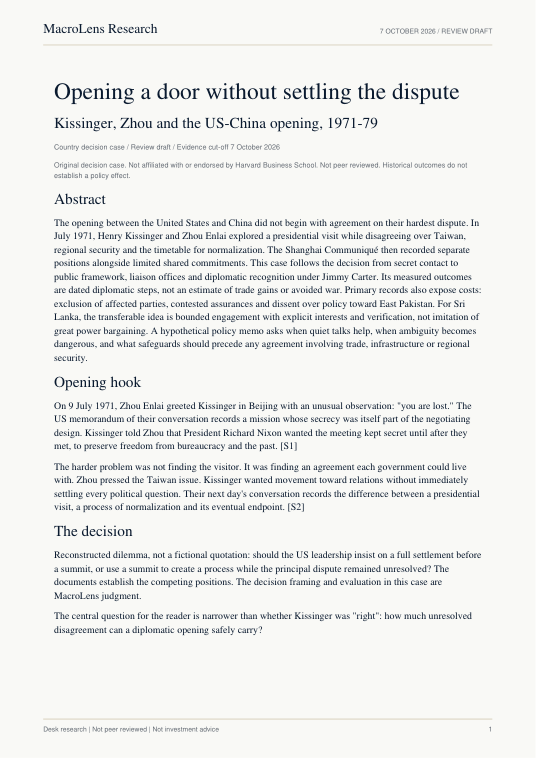
Opening a door without settling the dispute
A secret meeting opened a public relationship. The hardest dispute remained unresolved.
7 October 2026 / 7 pages / Review draft
Read the abstract
The opening between the United States and China did not begin with agreement on their hardest dispute. In July 1971, Henry Kissinger and Zhou Enlai explored a presidential visit while disagreeing over Taiwan, regional security and the timetable for normalization. The Shanghai Communiqué then recorded separate positions alongside limited shared commitments. This case follows the decision from secret contact to public framework, liaison offices and diplomatic recognition under Jimmy Carter. Its measured outcomes are dated diplomatic steps, not an estimate of trade gains or avoided war. Primary records also expose costs: exclusion of affected parties, contested assurances and dissent over policy toward East Pakistan. For Sri Lanka, the transferable idea is bounded engagement with explicit interests and verification, not imitation of great power bargaining. A hypothetical policy memo asks when quiet talks help, when ambiguity becomes dangerous, and what safeguards should precede any agreement involving trade, infrastructure or regional security.
Country case / Singapore
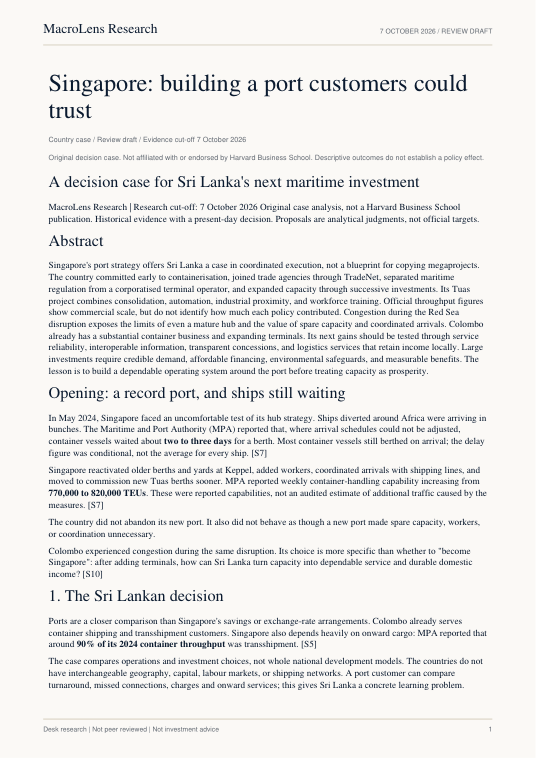
Singapore: building a port customers could trust
A record port still faced queues. Singapore shows why reliability, shared information and staged investment matter beyond new berths.
7 October 2026 / 8-page decision case / Review draft
Country case / Philippines
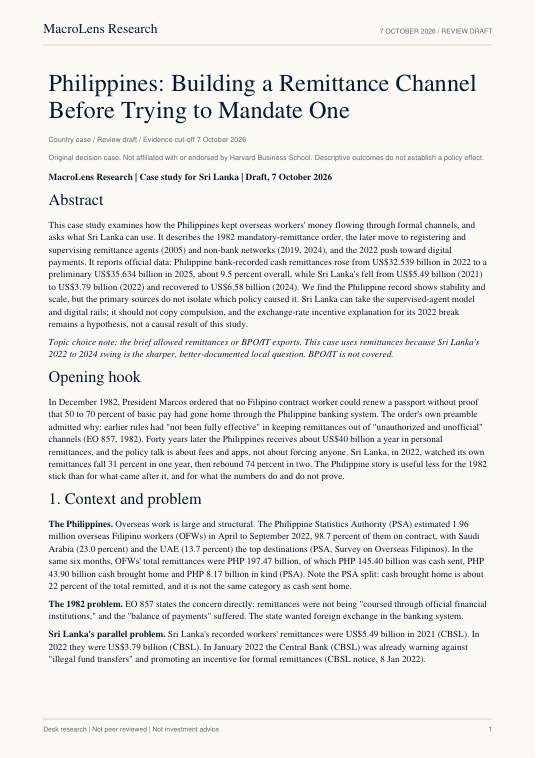
Philippines: Building a Remittance Channel Before Trying to Mandate One
Formal channels grew alongside supervision and digital rails. Which lessons survive when Sri Lanka faces a different incentive problem?
7 October 2026 / 6-page decision case / Review draft
Country case / India
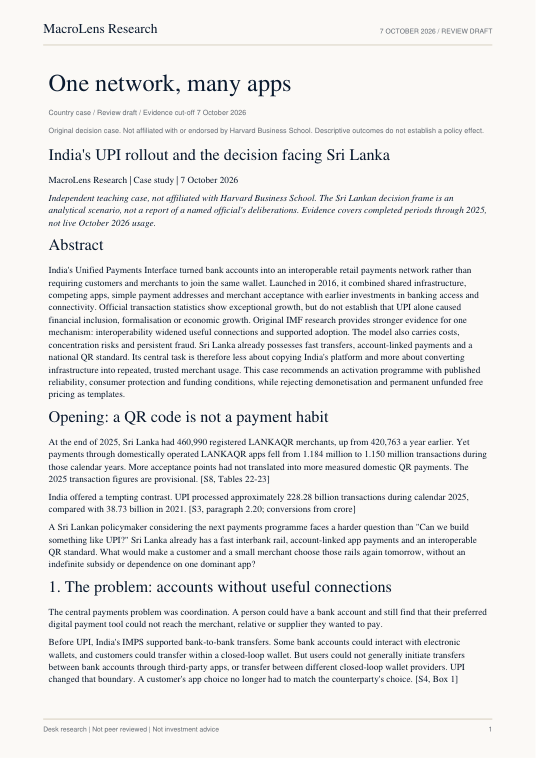
One network, many apps
One network, many apps. India shows the promise of interoperability, while Sri Lanka must test repeat use, funding and protection.
7 October 2026 / 7-page decision case / Review draft
Country case / Malaysia
Malaysia: Climbing the Chip Ladder from the Assembly Bench
Decades of electronics exports did not finish the upgrading task. Sri Lanka can study skills, sequencing and the difference between exports and local value.
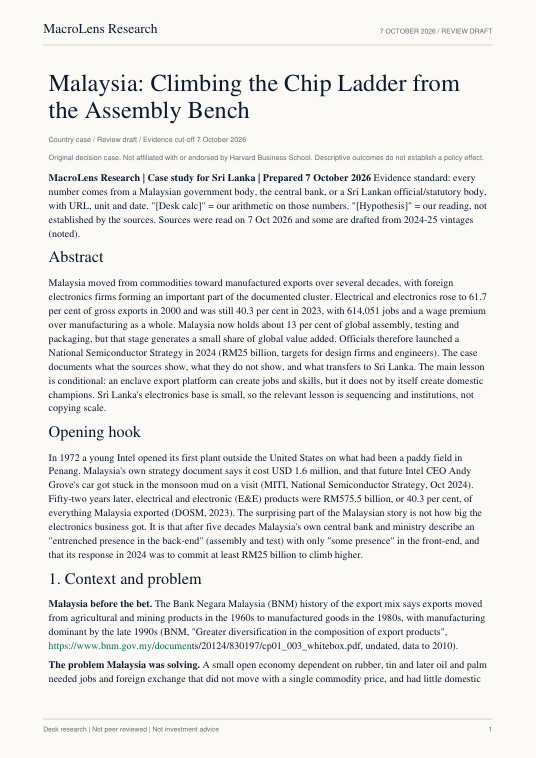
7 October 2026 / 5-page decision case / Review draft